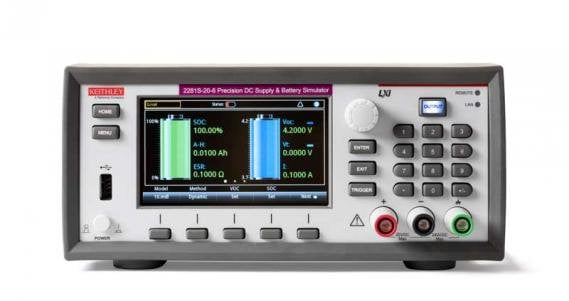
Features:
- Simulate a battery’s output during the charge and discharge cycles
- Create, edit, import, and export battery models
- Build a library of battery models using a Source Measure instrument as a model generator
- Display the real-time change of the SOC, Voc, and Vt for the simulated battery
- Compute battery capacity in Amp-Hour and Equivalent Series Resistance (ESR)
- Program the battery SOC, Voc, capacity, and internal resistance (ESR)
- Provide two modes of simulation–dynamic and static
- Monitor charge/discharge current and voltage
- Output up to 120 W of low noise, linear regulated power
- Monitor load currents from 100 nA to 6 A with high accuracy in power supply mode
- Measure voltage and current with 6½-digit resolution
- Sink current up to 1 A and source current up to 6 A
- Built-in graphing simplifies analyzing trends or displaying voltage or current waveforms
- High resolution TFT display and soft-key/icon-based user interface simplify operation
- Digital I/O for direct communication with other devices and instruments
- GPIB, USB, and LAN interfaces
- Emulation of front panel display and controls via your web browser simplifies automated control and monitoring
|
Description:
The Series 2281S Battery Simulator and Precision DC Power Supply innovatively integrates battery simulation with the functions of a high-precision power supply. The 2281S-20-6 can analyze the DC current consumption of a device under test and generate a battery model based on a battery charging process, and simulate a battery based on a battery model. The 2281S-20-6 can output 120 W with 20 V and 6 A, and sink current up to 1 A. The 2281S uses linear regulation to ensure low-output noise and superior load current measurement sensitivity. A high resolution color thin film transistor (TFT) screen displays a wide range of information on measurements. Soft-key buttons and a navigation wheel combine with the TFT display to provide an easy-to-navigate user interface that accelerates instrument setup and operation. In addition, built-in plotting functions allow monitoring trends such as drift. These features provide the flexibility required for both benchtop and automated test system applications. In addition, the 2281S provides a list mode, triggers, and other speed optimization functions to minimize test time in automated testing applications. |